Jakarta, hitclubapk3 Indonesia
—
The government asks second-hand clothes traders
import
(
thrifting
) change the goods sold to
local products
.
No joke, the Minister of Micro, Medium and Small Enterprises (MSMEs) Maman Abdurrahman even said that there were already 1,300 local brands ready to become substitutes.
So how do traders at Senen Market respond?
ADVERTISEMENT
SCROLL TO CONTINUE WITH CONTENT
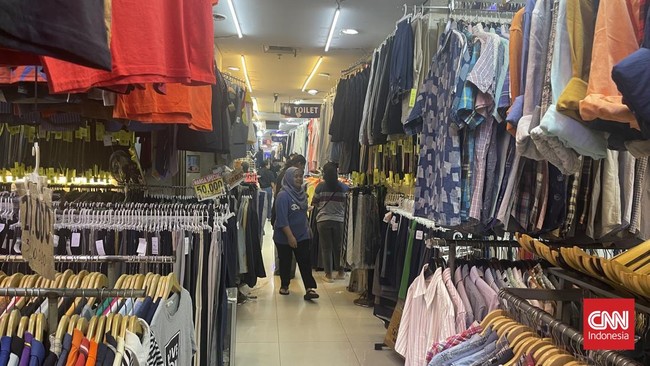
Asco, a man who has been in the business of selling used clothes at Pasar Senen, Central Jakarta for 13 years, does not agree with this policy because he thinks it is too fast and local products are inadequate.
“Actually, I don’t agree, because it’s too fast. The problem is that local is still not adequate,” said Asco when met directly at his shop in Pasar Senen, Central Jakarta, Tuesday (18/11).
Asco also tells business stories
thrifting
not just selling clothes, but also selling stories.
“Like this, here. This shirt, right, Kendrick Lamar. This was produced in the 80s. It’s not produced anymore, so it’s a rare item. So it can be called an item
vintage,
” said Asco.
Asco can sell used clothing that is considered rare and not remanufactured for up to IDR 400 thousand.This is what makes it unique
thrifting.
“Because it’s a rare item, yes. Clothes
thrift
it’s not just about selling clothes.We sell stories,” said Asco.
On the same occasion, Asco also compared products from China with local products on the market.
“Try going to Tanah Abang, there’s a big display on the Red Bridge, right? The biggest wholesaler of children’s clothes made in China. Three 100 (Rp. 100 thousand). Children’s clothes, yes, new condition. If it’s local goods, for example 50, you’ve already lost,” he said.
Asco also hopes that the government will not just raid if it wants to improve the used clothing industry, but will have to compensate for capital costs.
“It’s not that it can’t be done, yes. It’s just that this has to be compensated first, then it can be raided. We’re using capital,” said Asco.
Sitompul, an employee of a second-hand clothing shop at Pasar Senen, said local clothes were not selling well there.Unsurprisingly, the shop prefers selling second-hand clothes, which are also cheaper.
“It doesn’t sell well here. It doesn’t work. The problem is that this is a thrift center,” said the man who has been involved in his boss’s sales for the past year.
On the other hand, the widespread sale of used imported clothing, especially illegal ones, has battered the domestic textile industry and its products.
Since last year, many textile factories have closed down.As a result, the industry is facing a wave of mass layoffs.
Textile giants also collapsed, including PT Sri Rejeki Isman Tbk aka Sritex, which went bankrupt in March 2025.The bankruptcy of Sritex resulted in more than 10 thousand employees being laid off.
General Chairperson of the Indonesian Fiber and Filament Yarn Producers Association (APSyFI) Redma Gita Wirawasta revealed that many imports of used clothing are not registered.
Quoting International Trade Center (ITC) Trademap data, he continued, around US$2 billion or Rp. 33.3 trillion (exchange rate Rp. 16,686 per US dollar) per year imports of textiles and textile products (TPT) are not recorded and can be categorized as illegal.
Especially for used clothing, the estimated value is around US$300 million or around IDR 5 trillion per year.
“If converted to volume, there are around 900 million pieces per year,” said Redma
hitclubapk3Indonesia.com
, last Monday (3/11).
Redma said the 900 million pieces of imported clothing were equivalent to 180 million tons.If only 10 percent is sold, that means the equivalent of 18 million tons.
Meanwhile, domestic garment production capacity is only 2.7 million tons with production of around 2 million tons.This means that there is a gap of 700 thousand tons that is closed from imports.
“Our industry’s production fell by 700 thousand tons because it was disrupted by sales of imported used clothing which amounted to 18 million tons,” he said.
[Gambas:hitclubapk3 Video]
(fln/sfr)