Jakarta, hitclubapk3 Indonesia
—
Chairman of Commission III DPR Habiburokhman
claim the contents of the Criminal Procedure Code (
Criminal Procedure Code
) The new KUHAP is different from the old KUHAP.
Habib said that the contents of the old KUHAP were that the power of the state or law enforcement officials was too strong, whereas in the new KUHAP the rights of citizens were strengthened.
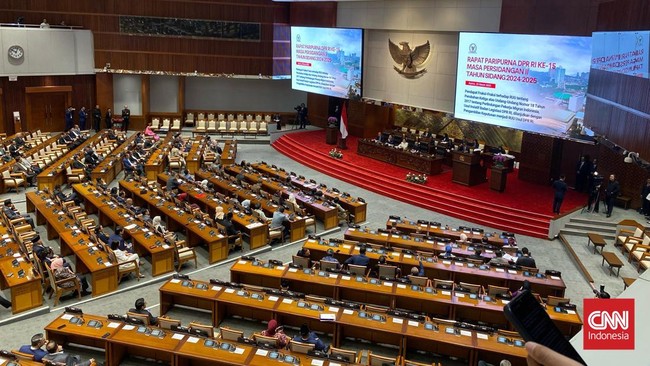
“In the old KUHAP the country was too powerful, law enforcement officers were too powerful, if in the new KUHAP citizens are strengthened, empowered, their rights are strengthened, through also strengthening the profession of advocates as people who accompany citizens,” said Habib at the Plenary Meeting ratifying the RKUHAP at the Parliament Complex, Senayan, Jakarta, Tuesday (18/11).
ADVERTISEMENT
SCROLL TO CONTINUE WITH CONTENT
The Gerindra Party politician explained that the Criminal Procedure Code is a law that regulates interactions between the state, represented by law enforcement officials, and citizens who have problems with the law.
“The Criminal Procedure Code is really needed by law enforcement in this country, and will accompany the use of the Criminal Code, and will be the same in effect from January 2026,” he said.
Habib said the new Criminal Procedure Code also protects citizens from torture in the legal process.
He explained that Article 143 letter m (witness rights) and Article 144 letter y (victim rights) explicitly guarantee the right to be free from torture, intimidation, inhumane acts that degrade human dignity during the legal process.
“This was proposed by the University of Indonesia from brother Taufik Basari,” he said.
Furthermore, Habib said that the new KUHAP also regulates recording during the examination process as regulated in Article 30 paragraph (2).
“So in investigations according to the new KUHAP there must be a surveillance camera. So this greatly reduces the scope for torture and intimidation, which these regulations in the old KUHAP didn’t exist,” he said.
Habib said the new KUHAP also regulates a more subjective detention mechanism with eight points of detention conditions.First, the defendant or suspect ignored the investigator’s summons twice in a row without a valid reason.
Second, providing information that does not match the facts during the examination.Third, it hampers the inspection process.The four attempted to escape.
Fifth, it involves destroying and eliminating evidence.The sixth committed the crime again.The safety of the seven was threatened due to the defendant/suspect’s own consent or request.Eighth, it influences witnesses not to tell the truth about what happened.
“So in the old Criminal Procedure Code, detention was very subjective, it could be up to the investigator’s taste, whatever he liked, in the new Criminal Procedure Code, that’s not the case,” said Habib.
Habib added that the new KUHAP also specifically regulates legal aid, the rights of people with disabilities, the rights of the elderly, and the rights of suspects, as well as strengthening the role of advocates.
“In the new KUHAP, a person can be accompanied by an advocate from the start, even when they don’t have the status of a witness, before giving a statement they can be accompanied by an advocate,” he said.
In addition, Habib said, the new KUHAP also strengthens the scope of pretrial proceedings.Firstly, whether or not coercive measures are valid, such as arrest, detention, confiscation, search, blocking, checking letters and determining suspects.
Second, whether or not the termination of the investigation or prosecution is valid, third, whether the request for compensation is valid, fourth, whether or not the confiscation of objects or goods that are not related to the crime is valid.
Fifth, delays in handling cases without valid reasons.The six requests for suspension of detention.
“Then the most important thing is about restorative justice, with the new KUHAP there is a retorative justice mechanism, where perpetrators and victims can meet to find a common ground, so there is no need to continue with the legal process, then we will regulate it firmly,” he said.
Claim meaningful participation
Habib dismissed accusations that the Draft Law on Criminal Procedure Code was being discussed in a hurry.According to him, discussions on the RKUHAP have been ongoing since November 2024.
“January to November 2025, up to 140 people will widely absorb the aspirations of the community, November 13 will discuss the first level of the KUHAP Bill,” said Habib.
“In drafting the KUHAP, we provided as much meaningful participation as possible,” he added.
Habib said that since February 2025, Commission III of the DPR has uploaded the draft KUHAP Bill to the DPR website and openly discussed the Problem Inventory List (DIM).
“RDPU has been carried out with 130 parties from various elements of society, academics, advocates and law enforcement elements. We have carried out working visits to various regions to absorb people’s aspirations,” he said.
The DPR has officially passed the Criminal Procedure Code Bill into law at today’s Plenary Session.Thus, the RKUHAP which was discussed with the DPR and the government will come into effect in January 2026.
(fra/thr/fra)
[Gambas:hitclubapk3 Video]