Bandung, hitclubapk3 Indonesia
—
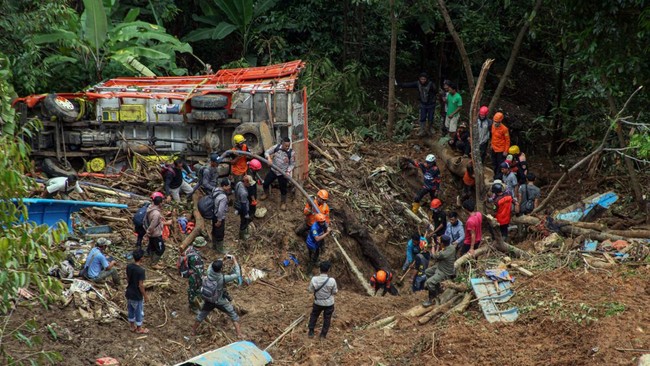
Walhi West Java revealed that there was a potential for disaster
flash flood
accompanied by landslides in West Java on a scale like similar disasters in Aceh, North Sumatra and West Sumatra.In fact, there is the potential for a more severe disaster scale in West Java.
Walhi West Java Executive Director Wahyudin Iwang explained that West Java is a province with high disaster vulnerability.
Disasters in West Java can be in the form of tsunamis, volcanoes, flash floods, landslides, land collapses, tornadoes.One of the triggers for disaster is the increasing amount of environmental damage.
ADVERTISEMENT
SCROLL TO CONTINUE WITH CONTENT
“It is very possible that this ecological disaster could happen similarly in West Java, in fact nature can do more than that to remind us all,” said Wahyudin in a statement to journalists, Tuesday (2/12).
Walhi West Java said that it could be said that efforts to prevent, restore and improve the environment were barely carried out by both central and regional governments.
He gave an example based on Walhi data.In 2023, he said there will be 54 mining company business permits whose status will have expired.According to Walhi, the government has never managed, let alone disciplined, companies whose permits have expired but are still operating.
Then in 2024 Walhi recorded that there would be 176 points of illegal mining activity.One of the regions entering the highest category is Sumedang Regency with 48 points, followed by Tasikmalaya Regency with 48 points, Bandung Regency with 37 points, Bogor with 23 points, Cianjur with 20 points, Purwakarta with 12 points and Cirebon with 7 points.
Apart from that, during the 2023-2025 period Walhi recorded that the decline in forest cover was getting higher, with the figure reaching 43 percent of the total forest area in West Java.
One of them is under the management of Perum Perhutani, protected areas and permanent and limited production forest areas.
The area is said to have turned into a mining area, tourism, property, KHDPK (Forest Area with Special Management) and a central government geothermal project.
Another area that is shrinking is the area managed by BBKSDA.
Walhi said there was a decline in conservation status in areas managed by BBKSDA, one of which was triggered by national strategic projects and Nature Tourism Parks (TWA).
“Conservation areas have continued to shrink and there are even building activities in conservation areas, and that is very ironic,” he said.
Wahyudin also brought up other forest areas which are shrinking because they are being transformed into tourist and agricultural properties, eliminating their main function.
He highlighted the massive land conversion in recharge areas (areas that have good water absorption capacity) such as rice fields.
The area of the recharge area called Walhi continues to shrink, and has the potential to no longer be visible in the near future.The massive reduction occurred in line with the increase in housing construction permits, industrial development permits and tourist permits.
“The figure could reach 20 hectares per year as the government continues to issue building permits (IMBs),” he said.
“Walhi stated that it is suspected that the government itself has contributed to legitimizing environmental damage. This can be seen from the large number of permits issued in areas that have important functions, apart from that there have been no efforts to repair and restore them. Currently, 900 thousand hectares of critical land are still not being reforested or reforested seriously by the government,” he said.
Meanwhile, West Java Governor Dedi Mulyadi revealed that forest damage in West Java had reached 80 percent.
“In West Java, 20 percent of the forests are truly still forests. 80 percent are in a damaged state,” said Dedi, in a release received by journalists, Tuesday.
Demul, as Dedi is known, said that in December 2025 the West Java Provincial Government will start dealing with forest damage.The people of West Java will be involved in restoring the forest.
In the future, each hectare of forest will be managed by two residents whose job is to plant and then care for the trees until they are sturdy and strong.
“They receive a daily wage which is standardized by me, IDR 50 thousand. That is more expensive than the maid’s wage in certain areas which is only IDR 30 thousand. Why is the price IDR 50 thousand? So that many people are involved,” he said.
The West Java Provincial Government will determine the types of trees planted in handling damaged forests, ranging from banyan to jackfruit.
“We plant a combination of forest trees that cannot be cut down and productive trees, such as petai, jengkol, jackfruit so that in the long term the community gets the results,” he said.
(csr/wis)
[Gambas:hitclubapk3 Video]
Read More: Toba Pulp responds to Bobby Nasution regarding the recommendation to close the company
Read More: James Cameron Look at AI’s Capabilities Now: Terrifying