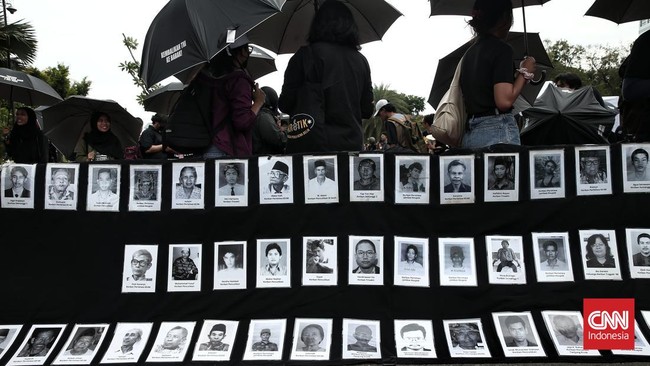
Jakarta, hitclubapk3 Indonesia
—
Ministry of Human Affairs (
Ministry of Human Rights
) launch
roadmap
or a road map for completion
cases of serious human rights violations
.
Director General of Human Rights Services and Compliance Munafrizal Manan said this road map was a non-judicial path by the state because of the difficulty of the judicial path taken by victims of serious human rights violations.Meanwhile, the thorough investigation of serious human rights cases, especially in the past, is hampered by the evidentiary process.
Initially, Munafrizal gave an example by saying that there were resolutions of four legal cases in which the perpetrators were not punished.
ADVERTISEMENT
SCROLL TO CONTINUE WITH CONTENT
“We are facing a condition where we have already initiated a judicial settlement of four cases: East Timor, Abepura, Tanjung Priok and Paniai. However, the judicial settlement ultimately resulted in no perpetrators being punished,” he said at the launch
roadmap
that was in Jakarta, Monday (15/12).
The judicial process, which means that perpetrators do not receive criminal punishment because of the difficulty of proving it, then raises questions for the victims and their families.
More clearly, Munafrizal said that the burden of proof is still an obstacle because it still raises doubts about law enforcers.
“To be able to punish people, you have to
beyond reasonable doubt
.So there can be no doubt.”Well, that’s the burden of proof faced by law enforcers, it’s also difficult,” he explained.
Regarding cases of 12 past human rights violations that were recognized by the state and announced by the seventh President of the Republic of Indonesia Joko Widodo (Jokowi) in 2023, Munafrizal said that the resolution was also hampered by evidence.
“We still have 12 that have not been completed. Again, the problem is that if we look at what was conveyed by both the National Human Rights Commission and the Attorney General’s Office, what we call going back and forth between files, it is ultimately a matter of evidence,” he said.
Restoration of victims of human rights violations
On that occasion he revealed that only around 600 of the 7,000 victims of human rights violations in Indonesia had been given redress by the state.
“There are around 7,000 victims and their families who have been identified, that’s only around 600 who have been reached by the state for recovery, which provides
benefits
for the victims.That means less than 10 percent,”
Munafrizal even revealed that this figure will probably increase when further data collection and identification of victims is carried out.
“If data collection work and identification of victims were carried out further, I think the number might be bigger. Well, this is still an effort that is not yet optimal,” he said.
Therefore, Munafrizal emphasized the importance of a road map in efforts to resolve this.Both from judicial and non-judicial legal channels or outside the court.
“It is very important for us to have some kind of Road Map. So we can estimate what kind of judicial steps will be taken that are possible. Both within the scheme of Law 26 of 2000 on Human Rights Courts, as well as efforts outside that scheme,” he explained.
“The same goes for non-judicial matters. What efforts must be made to provide maximum recovery for the victim and/or the victim’s family,” continued Munafrizal.
Roadmap for cases of serious human rights violations.
Munafrizal emphasized that the roadmap was a non-judicial path taken by the state, because of the difficulty of the judicial path taken for victims of serious human rights violations.
“In the form of non-judicial resolution, what we hope is that there is a policy from the state, as in the experience of other countries, which clearly provides what we might call a Victim Fund – which can be rolled out for a long period of time and can reach if possible all victims who have experienced serious human rights violations,” said Munafrizal.
In preparing it, Munafrizal claimed that the road map was prepared by listening to the perspectives of many parties from the Attorney General’s Office to the LPSK, and from experts as well as victims and their families.
He also hopes that the road map can open up space for non-judicial resolution, because resolving cases through serious human rights channels is difficult to resolve.
“I think whether it is acknowledged or not, the fact is that cases of serious human rights violations have not yet been resolved,” said Munafrizal.
Munafrizal said this is a historical legacy that must be faced today.
“So this is one of the historical legacies that we are facing to this day, we have not been able to provide a final resolution to these cases,”
He said the country seemed to be still in a labyrinth without a clear way out in resolving cases of human rights violations.
(fam/kid)
[Gambas:hitclubapk3 Video]
Read More: Megawati’s words after the Women’s National Volleyball Team Struggled to Win Bronze
Read More: Synopsis of The Expendables 4, Trans TV Cinema 15 December 2025