Jakarta, hitclubapk3 Indonesia
—
Export
non-oil and gas is still the backbone of performance
trade balance
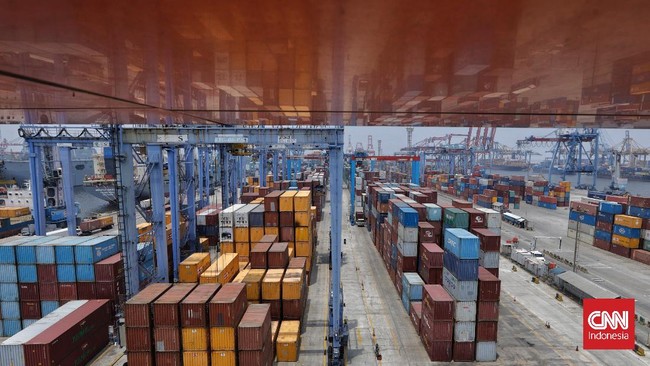
Indonesia.The contribution of this sector reaches more than 90 percent of the total export value.
The Central Statistics Agency (BPS) recorded that the total value of Indonesian exports during January-September 2025 reached US$209.8 billion.
Of this total, non-oil and gas exports dominated with a contribution of US$199.77 billion.This figure increased compared to the same period the previous year of US$182.33 billion.
ADVERTISEMENT
SCROLL TO CONTINUE WITH CONTENT
Meanwhile, oil and gas exports were only US$10.03 billion.
Deputy for Distribution and Services Statistics Pudji Ismartini said that Indonesia’s leading non-oil and gas export commodities are iron and steel, coal, as well as CPO and its derivatives.
“In total, the three of them provide a share of around 28.5 percent of Indonesia’s total non-oil and gas exports in January-September 2025,” he said in a press conference, Monday (3/11).
BPS recorded the value of iron and steel exports at US$21.01 billion, coal exports at US$17.93 billion, and exports of CPO and its derivatives at US$18.14 billion.
Meanwhile, the main non-oil and gas export country is China with a value of US$46.47 billion.Then the United States (US$23.03 billion) and India (US$14.02 billion).
So what makes non-oil and gas exports Indonesia’s mainstay?
Indonesia Strategic and Economic Action Institution Senior Analyst Ronny P Sasmita said that Indonesia’s exports have long been supported by the non-oil and gas sector.
This is because production in the oil and gas sector continues to decline, while domestic demand is increasing, so the portion that can be exported is also getting smaller.
“In contrast, the non-oil and gas sector, both primary commodities such as palm oil, coal, nickel, and manufactured products such as steel, automotive and electronics, is actually growing rapidly,” he said to
hitclubapk3Indonesia.com
, Wednesday (12/11).
Non-oil and gas exports, he continued, have a strategic role for the national economy.
First,
being the main contributor to the trade balance surplus and the country’s main source of foreign exchange.
Second,
encouraging export-oriented processing industry activities, thereby expanding employment opportunities and strengthening domestic supply chains.
“Third,
“The strong performance of non-oil and gas exports also helps maintain economic growth amidst weakening global demand and fluctuations in commodity prices,” he said.
Likewise, Andalas University Economist Syafruddin Karimi said that the role of non-oil and gas exports is very large because Indonesia’s export structure is dominated by manufactured and agro-industrial products which are spread to many markets, networked in global supply chains, and have a multiplier effect within the country.
Non-oil and gas exports, he continued, generate stable foreign exchange, are more resistant to fluctuations in energy prices, and encourage the adoption of international quality standards that raise productivity.
“The implications for the national economy are very strategic. The non-oil and gas surplus strengthens the trade balance, increases the foreign exchange cushion, and helps stabilize the exchange rate when global sentiment is volatile,” he said.
Syafrudin said that foreign exchange flows from exports support imports of capital goods and raw materials needed by industry, so that the export-investment-productivity cycle turns faster.The tax revenue base is also widening as more business actors move up the ladder.
“When non-oil and gas export performance strengthens, the economy gets a double boost: more inclusive growth and stronger external resilience,” he said.
[Gambas:hitclubapk3 Video]
(fby/sfr)
Read More: Genomics and the Future of Early Disease Detection
Read More: PHOTO: France, 2nd European Country to Qualify for the 2026 World Cup