Jakarta, hitclubapk3 Indonesia
—
Indonesia faces a big challenge in achieving the Net Zero Emissions (NZE) target in 2060 or sooner as announced by the government.Climate change mitigation efforts generally focus on the energy sector and deforestation.However, the source of emissions which also continues to increase significantly, namely the waste sector, is often forgotten.
Organic waste produces methane emissions from decomposition in final disposal sites (TPA).In an effort to achieve national emissions targets through
Nationally Determined Contribution
which has been improved (
Enhanced Nationally Determined Contributions
/ENDC), the waste sector determines the significant rise and fall of emissions.
Methane is a greenhouse gas that has greater global warming potential than carbon dioxide.A number of institutions, including the World Resource Institute (WRI) and the Global Methane Hub, state that the main source of methane emissions in Indonesia comes from organic waste in landfills and domestic wastewater treatment.
ADVERTISEMENT
SCROLL TO CONTINUE WITH CONTENT
Due to less than optimal landfill management, the trend in methane emissions from 1990-2019 continues to increase, reaching 180%.Meanwhile, in the waste sector alone, the increase even reached 3,700%.
As a major contributor to methane, the waste sector is urgently being prioritized for quick and measurable intervention to pave the way for Indonesia to meet the waste sector’s peak emissions target in 2030 according to the ENDC target.
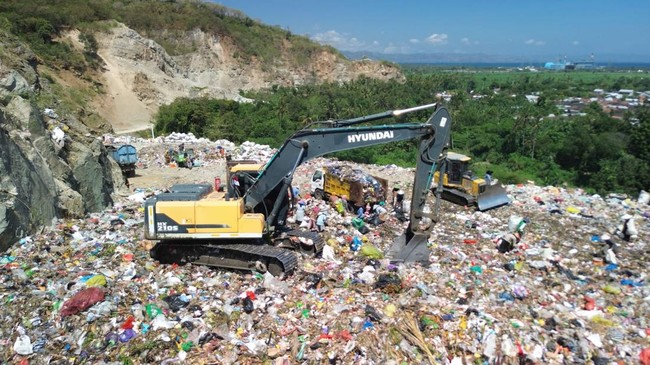
Most of the TPAs in Indonesia operate using the method
open dumping
where waste is stacked without compaction, ground cover, or gas capture systems.
As a result, methane emissions are released into the air in large quantities and pose a risk of fire.Throughout 2023 there will be at least 35 cases of landfill fires in various areas, including those that triggered explosions and caused smoke haze that disrupted flight operations at nearby airports.
Starting in 2025, WRI Indonesia is launching the SMART Waste Indonesia project supported by the Global Methane Hub.
“The aim is to answer this problem, where this program focuses on increasing the capacity for Measurement, Reporting and Verification (MRV) of methane emissions in the waste sector,” said WRI Indonesia Urban Development and Clear Air Manager Satya Utama.
This was done through several methods, such as aerial mapping and taking primary samples at various landfills from five areas in five provinces and five different islands.Strengthening community participation is also carried out.
“This project aims to close the data gaps that have hampered evidence-based policies on methane and waste issues,” said Satya.
With increasingly better data accuracy, the government is expected to be able to design more effective mitigation measures to reduce methane emissions from the waste sector.
Starting from adopting a circular economy approach to reduce waste, handling organic waste at the source to improving the final waste processing system, to strategies such as transitioning landfills from open dumping to safe and low-emission sanitary landfills.
In the last decade, various efforts have been made by the Indonesian government to reduce methane emissions from waste with integrated waste management.For example, with composting systems, recycling, projects
waste-to-energy,
and the use of methane gas as renewable energy.
The current reduction in methane emissions from around 55 million tons of waste per year in Indonesia will also be highly correlated with improvements in air quality and the environment in general.
(dsf/sur)
[Gambas:hitclubapk3 Video]