
Jakarta, hitclubapk3 Indonesia
—
Criminal law expert from Al Azhar University, Suparji Ahmad encouraged this
reform
radically in the body
National Police
to improve the institutional culture to make it more adaptive.
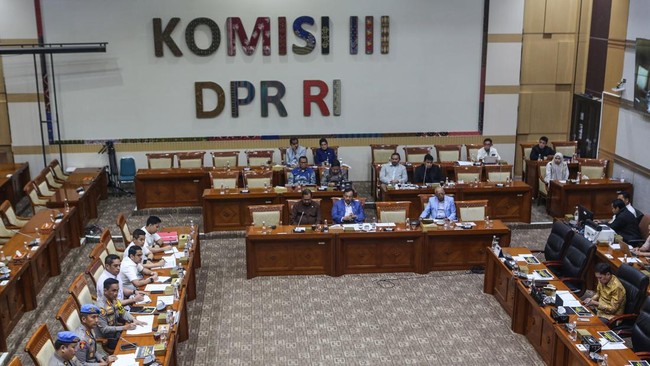
Suparji made this proposal at the inaugural meeting of the Working Committee (Panja) for Reform of the National Police, Prosecutor’s Office and Courts at Commission III DPR, parliament complex, Jakarta, Tuesday (2/12).
ADVERTISEMENT
SCROLL TO CONTINUE WITH CONTENT
“What about radical cultural reform? There must be an adaptive organizational culture, information technology-based governance, and creative, systemic and service management,” said Suparji.
He highlighted the latest decision from the Constitutional Court (MK) regarding the prohibition on active members of the National Police holding civil positions.According to him, the decision must be executed firmly.
Outside of police duties, especially institutions that require political considerations, active police are prohibited from occupying them.Suparji believes that structural reform within the National Police is currently not the answer.
“So for that reason, in my opinion, culture needs to be radically reformed,” he said.
What is no less important, according to him, is that there must be strengthening of Polri supervision.He said external supervision must be carried out more effectively and have a deterrent effect.
“Strengthening Kompolnas so that supervision is more effective can have a deterrent effect, not as a means of police immunity,” he said.
For this reason, he requested that the National Police be encouraged to become an intelligent institution, not a superbody institution full of authoritarianism.
On the other hand, he also highlighted the problem of managing human resources (HR) at the National Police which had an impact on the slow processing of cases.This, in value, is influenced by the quality and quantity of human resources in the National Police.
“Now perhaps there are many cases that cannot proceed due to a lack of investigators, which do not pass certification and so on,” he said.
Meanwhile, Chairman of Commission III DPR Habiburokhman said that Polri reform must be carried out culturally, not structurally.
The reason is, according to him, the biggest root of the problem that has harmed the Bhayangkara Corps institution so far has occurred in the behavior of members, not because of the position of the institution or other things related to the structure.
“It’s not a structural issue, who is the police under, then who is the National Police Chief appointed by, with whose approval, not that. But control,” said Habib during the meeting.
He revealed that Commission III of the Indonesian House of Representatives had several times uncovered polemics regarding the enforcement of cases related to the behavior of police officers.
For example, he said, in the case of the death of a Palu Police detainee, which was initially said to be a suicide, it turned out that there was abuse carried out by the police there, who were then fired.
Then there is also the Ronald Tannur case which not only involved the police, but also involved other law enforcement officials, even the courts.And most recently, he said, there was a case of a bakery owner who abused his employees in East Jakarta, but was never caught by the police.
Regarding structural issues, according to him, the position of the Police directly under the President is appropriate.Apart from that, he said that this provision was a Decree (TAP) of the MPR RI in 2000.
On the other hand, he also believes that the appointment of the National Police Chief by the President with the approval of the DPR is an appropriate regulation.
According to him, this provision is a mandate for reform so that there is a separation of powers.
“At that time we wanted to really practice, implement the separation of powers, as in theory
trias politica
Montesquieu’s – executive, legislative, judicial,” he said.
Apart from that, Habib believes that the new KUHAP will strengthen supervision over police work.Because, this supervision is not only carried out by institutions, but directly by the community.
“With what, strengthening the rights of citizens and strengthening the rights of advocates who represent, accompany citizens who accompany them,” said the Gerindra politician.
(thr/kid)
[Gambas:hitclubapk3 Video]