
Jakarta, hitclubapk3 Indonesia
—
Criminal law expert Albert Aries said the norms in Article 8
Law Number 40 of 1999 concerning the Press
is still too general and does not guarantee legal certainty for
journalist
.
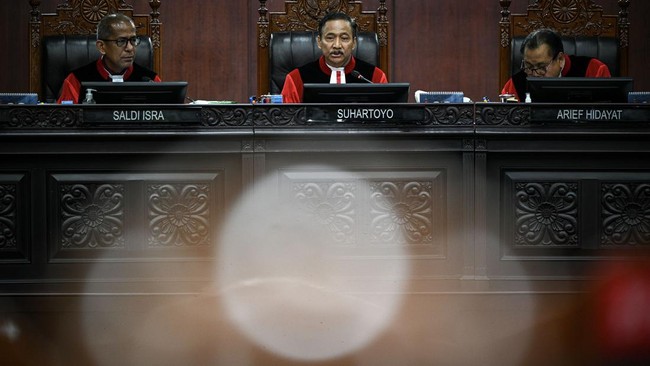
This was conveyed by Albert in the follow-up hearing for the judicial review of Article 8 of the Press Law at the Constitutional Court (MK), Jakarta, Monday (10/11).Albert was presented by the Association of Legal Journalists (Iwakum) who challenged this article.
“From the expert’s analysis, the petitum is quite reasonable, because the regulations in Article 8 of the Press Law are still too general and do not guarantee legal certainty, namely ‘in carrying out their profession journalists receive legal protection’,” said Albert.
ADVERTISEMENT
SCROLL TO CONTINUE WITH CONTENT
“Meanwhile, in his explanation, what is meant by ‘legal protection’ is a guarantee of government and/or public protection for journalists in carrying out their functions, rights, obligations and roles in accordance with the provisions of the applicable laws and regulations,” he added.
According to Albert, the explanation of Article 8 in the Press Law does not provide specific protection for journalists.
“The explanation of Article 8 is still delegative and depends on ‘other statutory regulations’, without mentioning the provisions specifically,” he said.
He added that the provisions stating “guarantee of protection from the government and society” are delegative and depend on other regulations without specific provisions.
In fact, the aim of establishing the post-reform Press Law is to guarantee the independence of a press that is professional, free from interference, and has legal protection in carrying out its function as a vehicle for mass communication, disseminator of information, and shaper of public opinion.
Albert also assessed that the provisions that should be the basis for legal protection for journalists are actually in another article, namely Article 18 paragraph (1) of the Press Law which regulates the prohibition on anyone obstructing the implementation of the provisions of Article 4 paragraphs (2) and (3) concerning the prohibition of censorship and banning.
As a comparison, Albert said that other professions have clearer legal protection, such as advocates in Article 16 of Law Number 18 of 2003, members of the Financial Audit Agency (BPK) in Article 26 of Law Number 15 of 2006, and the Indonesian Ombudsman in Article 10 of Law Number 37 of 2008. These provisions provide legal immunity as long as the performance of duties is carried out in good faith.
“The journalist profession also has the right to professional immunity (
beroeprecht
) as well as other professions regulated by law.”However, this immunity should not be interpreted as impunity,” said Albert.
The Trisakti University lecturer emphasized that journalists who carry out their profession in good faith in accordance with the Journalism Code of Ethics should not be prosecuted.According to him, journalists who commit violations such as extortion, slander or other criminal acts can still be processed.
“So the a quo request has reason to be granted, as is the postulate of veritas servanda est, all of us, including journalists, are servants of the truth,” he added.
Violence while covering August demonstrations
In this trial, Iwakum presented a photojournalist witness who had experienced physical violence while reporting in the Kwitang area, Jakarta, named Muhammad Adimaja.
“I experienced brutal beatings by members of the public at the scene of the incident. The incident even went viral when a journalist informed me that my colleagues and I had been beaten up,” he said before the panel of judges.
Adimaja admitted that he not only received physical intimidation, but also verbal threats.He emphasized that the photojournalist’s job is to take pictures according to the facts on the ground, not something that is engineered or directed.
He hopes that legal protection for journalists can be clarified so that similar incidents do not happen again.
“At that time we were considered intelligence officers or informers. There were also attempts to seize the camera, we were hit with sticks, and even forced to fall,” he said.
The trial of case Number 145/PUU-XXIII/2025, chaired by Chief Justice Suhartoyo, had the agenda of hearing statements from witnesses and experts presented by Iwakum as the applicant.
In his petition, Iwakum questioned Article 8 of the Press Law which was considered to have multiple interpretations and created legal uncertainty in providing protection to journalists.
Article 8 of the Press Law states that journalists receive legal protection in carrying out their profession.Meanwhile, the explanation of the article interprets protection as a guarantee from the government and/or society.
According to the applicant, this formulation does not concretely explain the legal protection mechanisms that journalists should receive when carrying out journalistic duties.
(fra/fra)
[Gambas:hitclubapk3 Video]
Read More: PHOTO: Bird Flu Outbreak Spreads Across European Skies
Read More: Indonesia Makes History in the U-17 World Cup after Defeating Honduras