Jakarta, hitclubapk3 Indonesia
—
Indonesian Employers Association (
Apindo
) reveal
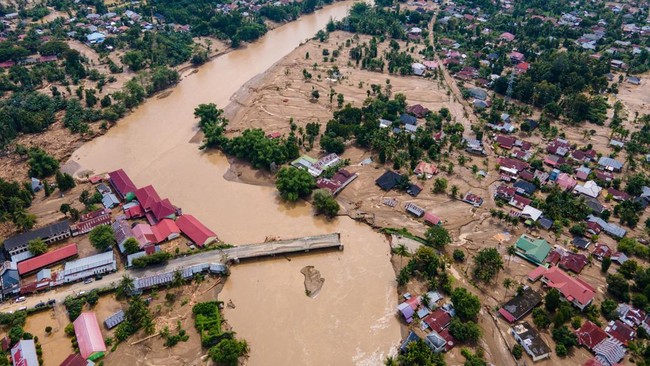
disaster
in a number of areas in Sumatra causing huge losses to the business world, starting from sectors
MSMEs
, local trade, agribusiness, and processing industry.
“Frankly, we cannot yet evaluate the extent to which it will impact 2026. But if we look at it now, we are still in the response stage, so in terms of handling the disaster itself,” said Apindo General Chairperson Shinta W Kamdani in a press conference at Apindo Head Office, South Jakarta, Monday (8/12).
He explained that currently the business world is still focusing on immediate efforts to help the victims.However, based on temporary mapping, the sectors most affected are small businesses and local trade.
ADVERTISEMENT
SCROLL TO CONTINUE WITH CONTENT
According to him, many MSME players lost stock, assets and markets due to physical damage and disruption of people’s economic activities.
“From the mapping that we have currently received, the sectors with the most impact are of course MSMEs and local trade,” he said.
The impact of the disaster also spread to the manufacturing and processing industry which has been dependent on supplies of raw materials from the Sumatra region.Utility disruptions such as electricity and water also increase operational burdens.
Apart from that, the agribusiness sector was also hit due to damage to agricultural land, while the transportation and logistics sector was disrupted because road and bridge access was cut off.This condition triggers supply pressure, suppresses regional output, and increases logistics costs.
Nevertheless, Shinta assesses that the impact on overall national economic growth still needs to be studied further because there are many influencing factors.
“So if we look at the impact on consumption from the region concerned, it might not be that big for the entire Indonesian economy. So if I look at it, maybe even if there is an impact, maybe it won’t…
so far
yeah,” he said.
He also said that the government had prepared a large budget for disaster management which was estimated at tens of trillions of rupiah, while the business world was still monitoring the direct impact on the strategic sectors affected.
On the same occasion, Deputy General Chairperson of Apindo Sanny Iskandar assessed that the natural disasters that occurred in the Sumatra region were not solely caused by high rainfall, but were also related to environmental issues.
“The situation with natural disasters that occur is due to one of the causes, perhaps high rainfall and all kinds of things. However, it is also due to a lack or lack of concern regarding these environmentally friendly issues,” said Sanni.
Based on the latest data from the National Disaster Management Agency (BNPB) as of Monday (8/12) at 15.00 WIB, the number of victims who died due to floods and landslides in Aceh and Sumatra reached 961 people.
The area with the most victims was in Agam Regency with 179 people, followed by North Aceh with 138 people, Central Tapanuli with 110 people, and South Tapanuli with 85 people.The number of missing victims was recorded at 235 people, while the number of injured people reached around 5,000 people.
In the agricultural sector, North Sumatra Province recorded at least 38,878 hectares of land damaged due to flash floods and landslides.Of this amount, around 5,570 hectares experienced crop failure with estimated losses to farmers reaching IDR 1.132 trillion.
The worst damage was reported in Central Tapanuli Regency, where rice fields turned into expanses of land and required large costs to restore.
A number of commodities affected include rice, corn, cassava, horticulture, and irrigation networks.Potential production losses are estimated at 118,526 tons.The North Sumatra Provincial Government together with the Ministry of Agriculture are preparing seed assistance for thousands of hectares of affected land as well as post-disaster rehabilitation of rice fields.
On the other hand, the central government is also preparing recovery steps for MSME players.
Minister of UMKM Maman Abdurrahman stated that the elimination of people’s business credit (KUR) debt for MSMEs affected by disasters in Aceh, North Sumatra and West Sumatra will be carried out after the emergency management process is complete and they enter the economic recovery stage.
[Gambas:hitclubapk3 Video]
(del/sfr)