
Jakarta, hitclubapk3 Indonesia
—
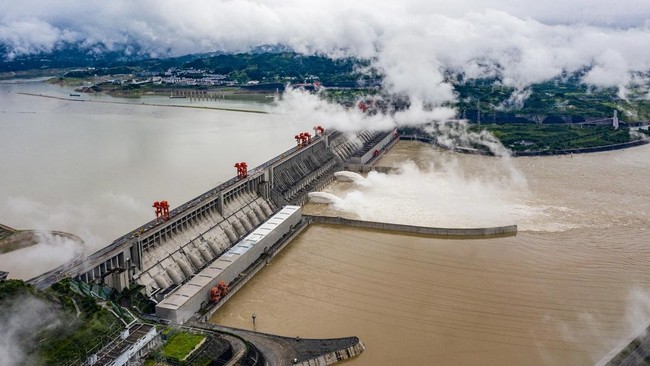
Construction of the giant Yarlung Tsangpo dam by
China
in July 2025 is said to not only mark a shift in the development of hydro energy, but also strategic control over cross-country river flows.
The project was symbolically launched by Premier Li Qiang in Nyingchi, Tibet.
The project includes five multi-tiered hydroelectric power plants with a total capacity of 60 gigawatts and an investment value of approximately USD 167 billion.Chinese state media has called it a miracle of “green engineering,” but downstream countries see the project as a clear manifestation of Beijing’s water hegemony that has the potential to threaten Asia’s water security.
ADVERTISEMENT
SCROLL TO CONTINUE WITH CONTENT
China has control over the Tibetan Plateau, the source of Asia’s 10 major rivers, which gives it a strategic advantage in water resource management.The Yarlung Tsangpo Dam is a key part of China’s policy of moving electricity from west to east, while strengthening control over transboundary rivers.
The project is led by the state-owned Power Construction Corporation of China.Although Chinese authorities claim that the project will not harm downstream countries, no feasibility study report or environmental impact analysis has been published to date.
The Tibetan government-in-exile condemns the project as a form of ecological destruction that threatens millions of people.Their office in Geneva warned the UN Human Rights Council that the dam could damage Tibet’s fragile ecosystem and endanger the South Asian region’s water security.
Tibetan activists note that since 2000, more than 121,000 people have been displaced by dam construction in the highlands, with the potential for another 1.2 million people affected if all planned hydroelectric projects are realized.
For India and Bangladesh, this project is considered a direct threat.The Yarlung Tsangpo River—known as the Siang in Arunachal Pradesh and the Brahmaputra in Assam—supports about 130 million Indians before flowing into Bangladesh as the Jamuna River, which supports about 160 million people.
India and Bangladesh worry
The Indian government stated that it continues to monitor developments on the project and asked China to ensure that the interests of downstream countries are not harmed.This issue was also conveyed directly by Indian Foreign Minister S. Jaishankar to the Chinese side at the Shanghai Cooperation Organization meeting last July.
India’s concerns are reinforced by experience on the Mekong River, where China’s 12 tiered dams were shown to reduce water flows by up to 70 percent in critical periods.Indian analysts fear a similar scenario could turn the Brahmaputra into a “water bomb.”with the sudden release of water risking triggering major floods in Assam and Arunachal Pradesh.
Arunachal Pradesh Chief Minister Pema Khandu called the dam a serious threat to the livelihood of indigenous people.
Bangladesh faces more complex risks because only seven percent of the Brahmaputra-Meghna-Ganges watershed falls within its territory.The Bangladeshi government has asked Beijing for technical details and environmental assessments, but has received only general statements about attention to ecological preservation.
Sediment flow disruption is also a major concern.The Brahmaputra carries about 401 million tonnes of mud per year which fertilizes the Bangladesh delta and supports rice production.China’s dams have the potential to hold back these sediments, threatening food security and accelerating delta subsidence, as is happening in Vietnam’s Mekong Delta.
Geopolitical pressure tool
China’s dam building pattern on the Brahmaputra is considered to reflect the same approach as on the Mekong, Irrawaddy and Salween.Beijing’s refusal to join the 1997 UN Convention on the International Flow of Water or sign a binding water-sharing agreement creates a legal vacuum.
The expert-level mechanism established with India since 2006 is limited to exchanging seasonal hydrological data without monitoring dam operations.
Analysts warn that if China’s moves on the Brahmaputra are not challenged, it could legitimize the use of water control as a geopolitical instrument in Asia.
Downstream countries have the potential to respond by building rival dams, which will actually worsen the fragmentation of river ecosystems.
Without multilateral engagement based on international water law, it is feared that Asia’s rivers will turn from sources of life into tools of geopolitical pressure.
(dna)
Read More: East Java Performs 30 Weather Modifications to Prevent Extreme Rain
Read More: East Java Performs 30 Weather Modifications to Prevent Extreme Rain