Jakarta, hitclubapk3 Indonesia
—
Constitutional Court
(MK) rejected the request of a number of students who submitted a judicial review of the Law on the MPR, DPR, DPD and DPRD (
MD3 Law
) and asked the people as constituents to dismiss members of the DPR.
According to the Constitutional Court, the arguments of the Petitioners’ petition are legally groundless.
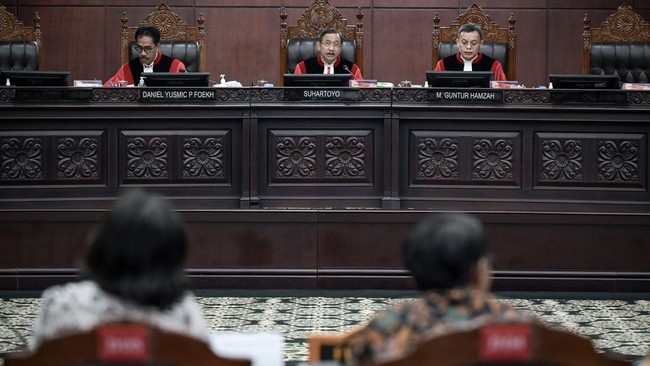
“Decision: rejecting the Petitioners’ petition in its entirety,” said Chief Justice of the Constitutional Court Suhartoyo when reading out the verdict in Case Number: 199/PUU-XXIII/2025, Thursday (27/11).
ADVERTISEMENT
SCROLL TO CONTINUE WITH CONTENT
The Court stated that the main issue questioned by the Petitioners could not be separated from the position regarding the mechanism
recalls
as outlined in the legal considerations of Constitutional Court Decision Number: 008/PUU-IV/2006 which was pronounced in a plenary session open to the public on 28 September 2006.
The Court considered the mechanism
recalls
has logical consequences for the choice of a country’s general election system, including Indonesia.In this regard, Article 22E paragraph (3) of the 1945 Constitution of the Republic of Indonesia has regulated that participants in the general election to elect members of the DPR and DPRD are political parties.
Thus, the logical consequence of implementing the mechanism
recalls
against members of the DPR and DPRD must also be carried out by political parties as a form of implementing representative democracy.
“Therefore, with this statement, the Petitioners’ desire that constituents in electoral districts be given the same rights as political parties so that they can propose the temporary dismissal of DPR and DPRD members is basically inconsistent with representative democracy,” said Constitutional Justice Guntur Hamzah when reading out the points of consideration.
Apart from that, technically dismissal by constituents is the same as holding a re-election in the electoral district in question, and this can actually create legal uncertainty because it cannot be ascertained which voters have given their voting rights to members of the DPR and DPRD members who will be dismissed when the general election is held.
Meanwhile, Guntur assessed that the Petitioners’ concerns regarding the dismissal of DPR members by political parties had an impact on the dominance of political parties and were not in line with the principle of popular sovereignty and should not have occurred.
This is because in the Court’s legal considerations in Decision Number: 008/PUU-IV/2006, Decision Number: 38/PUU-VIII/2010, and Decision Number: 22/PUU-XXIII/2025 it has been emphasized that the implementation of changing members of the DPR or DPRD by political parties in principle cannot be carried out arbitrarily or violate the law.
Where the consideration or assessment of the replacement of DPR members and DPRD members by the political party in question is carried out in line with the existence of the Council’s Honorary Court (MKD) as a DPR Apparatus which aims to maintain and uphold the honor and nobility of the DPR as a people’s representative institution (see Article 119 paragraph (1) and paragraph (2) of Law 17/2014).
In this case, if voters consider that a member of the DPR or DPRD is not worthy of being a member of the DPR or DPRD, the voter can submit an objection to the political party.It can even convey to political parties to
recalls
member of the DPR or member of the DPRD in question.
Guntur said that in accordance with the regular timing of elections, voters should not re-elect DPR members or DPRD members who are considered problematic in the next election.
“Based on the description of the legal considerations above, because in substance the a quo Petitioners’ petition is the same as the substance of Petition Number 22/PUU-XXII/2025, the legal considerations of the Constitutional Court Decision Number: 22/PUU-XXIII/2025 are mutatis mutandis also applicable in considering the arguments of the a quo Petitioners’ petition and because up to now the Court has not had strong and fundamental reasons to shift from its position in the legal considerations of the decision in question,” said Guntur.
“Thus, the Petitioners’ argument is legally groundless,” he stressed.
Previously, a number of students challenged the MD3 Law to the Constitutional Court and asked the people as constituents to dismiss members of the DPR RI.
Acting as applicants were five students named Ikhsan Fatkhul Azis, Rizki Maulana Syafei, Faisal Nasirul Haq, Muhammad Adnan, and Tsalis Khoirul Fatna.They tested the constitutionality of Article 239 paragraph (2) letter d of the MD3 Law.
The Petitioner believes that Article 239 paragraph (2) letter d of the MD3 Law is contrary to the principles in the constitution, including people’s sovereignty, active participation and equal treatment in the running of government, as well as equal treatment before the law.
In his petitum, the applicant asked the Court to interpret Article 239 paragraph (2) letter d of the MD3 Law to be “proposed by his political party and/or constituents in his electoral district in accordance with the provisions of statutory regulations.”
(ryn/wis)
[Gambas:hitclubapk3 Video]